
Trace Sullivan County Former Owners Transfer by Transfer
Start with the newest deed. Every chain built in Sullivan County property records begins with the current parcel, and each grantor named there opens the next search backward through the deed records.
| Transfer point | Grantor to grantee | Deed type | Book, page, or document |
|---|---|---|---|
| Newest recorded transfer | Seller to current grantee | Read the index | Copy the exact reference |
| Prior acquisition | Earlier owner to that seller | Read the index | Copy the exact reference |
| Next earlier link | Prior grantor to prior grantee | Read the index | Copy the exact reference |
Each grantor becomes the next grantee search. Before adding a previous owner of record to the chain, compare legal descriptions, parcel references, recording dates, and book-and-page citations in the Sullivan County deed records.
Cross Sullivan County's July 2004 Digital Boundary
The Doxpop recorded-document search carries Sullivan County index data and scanned images from July 2004 forward. Public users search by Person, Parcel, or Document. A result may list the indexed parties, their roles, the document type, and the recording date. It may also give a document number, a book/page reference, parcel or legal-description matches, cross-references, and image availability. That is recent coverage only. It is not where county land records begin. The Recorder traces the constitutional office to 1816 and describes more than 199 years of preservation, so a full former-owner project can move from the modern portal into locally held deed books.
Coverage limit. Sullivan County's online index and images begin in July 2004. Earlier owners require older indexes, deed books, or library microfilm.
Recognize the Sullivan County Former-Owner Index
The county-selected Doxpop search page is the starting point for recent former owners.
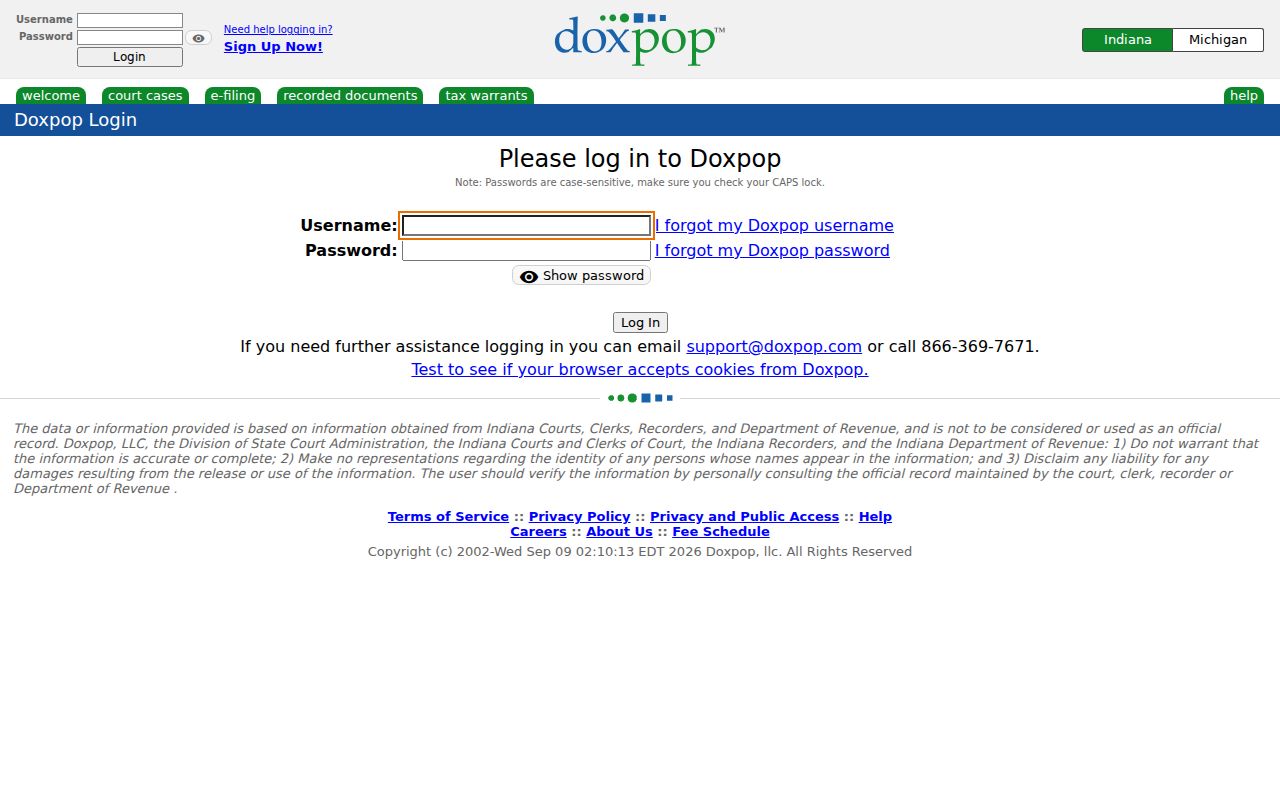
The index page names the service. The live search supplies current results. Expanded detail and scanned images may cost extra, so save the index citation from Sullivan County property records even when you skip the image purchase.
Reconstruct Sullivan County's Deed Chain Backward
The method does not change when paper replaces the portal. Sullivan County deed records verify each link through the land description, never through a matching surname alone.
- Open the newest deed and copy every grantor, grantee, recording date, reference, and legal description.
- Search the grantor as a grantee during the earlier period when that party likely acquired the land.
- Reject name matches that do not agree with the lot, block, section-township-range, or parcel lineage.
- Repeat one verified instrument at a time, then switch to older direct and reverse indexes at the cutoff.
- Grantor
- The party conveying an interest.
- Grantee
- The party receiving an interest.
- Chain of title
- The linked sequence of instruments affecting ownership.
- Reverse index
- An index organized by grantee rather than grantor.
- Quitclaim and warranty deed
- Different forms whose precise language must be read.
Continue Sullivan County Prior Owners at the Counter
The online trail ends somewhere. At that boundary, carry the last confirmed name, legal description, and book/page trail to the Sullivan County Recorder at 100 Courthouse Square, Room 205. Hours are weekdays, 8 a.m. to 4 p.m. Call 812-268-4844 first. Staff can confirm whether a volume is on site and whether copies can be mailed.
The Sullivan County Public Library offers another path. Its collections include deed and probate microfilm, wills, newspapers, cemetery resources, and county-history indexes, with requests taken online, by letter, email, or phone. The published research fee is $3 plus postage for up to 12 pages, then 10 cents for each added copy.
Note: Give the library a specific name, parcel or street, narrow year range, and requested reel, index, or book.
Place Sullivan County Previous Owners on Historic Maps
The Indiana State Library map list points to old Sullivan County sources. They include an 1899 atlas, a 1924 property-owner map, and plat books from 1925 to 1941. A 1939 Sullivan street map appears too. So do later farm atlases and a 2010 plat book with a landowner index. These maps bridge name and place before digital indexing.
Still, a map label is context. It is not title proof. Pair it with the recorded legal description, and treat the 1924 owner map as a lead for the next deed-book question rather than a claim on Sullivan County land.
Resolve Sullivan County Probate and Parcel Breaks
Some breaks need a courtroom, not a deed book. Probate orders, executor or administrator deeds, survivorship instruments, transfer-on-death documents, tax-sale deeds, and judgments. Each one interrupts a clean chain. Search a non-confidential estate in Indiana MyCase. Then ask the Sullivan County Clerk for the order that moved the land. Parcel splits break chains differently. Follow the parent parcels and the lot-and-block or metes-and-bounds language. A street address can change. The older land description still ties the Sullivan County property records together.
Explain Sullivan County Former Owners With Local Sources
Newspapers and cemetery files often explain a deed jump. A death date or heir can explain the gap. The library lists Sullivan Daily Times from 1924 to 1977 and Times-Democrat from 1925 to 1934. Its obituary index reaches from 1877 to the present, and Center Ridge Cemetery reports more than 10,000 graves, though it offers no public online interment search.
Treat these as leads. An obituary date may be the publication date. A cemetery transcription may include later updates, so a Sullivan County deed or court order remains the stronger record for ownership.
The will index covers books 1 through 7. Descriptions reach from 1850 into the 1930s. Probate and will microfilm can point to the estate file that explains a transfer, while the Sullivan County Clerk holds the court record itself. Search a specific decedent or representative rather than assuming every matching family name belonged to the parcel.
Pair each notice date with the next step. An estate sale, sheriff sale, road change, or family death may explain why a Sullivan County deed was recorded when it was. But timing alone proves little. Only the linked deed or court order confirms how the land interest moved through the Sullivan County property records.
Measure Sullivan County Ownership Record Depth
The online record trail has a firm stopping point. Beyond it, the county has never published a full year span for its deed microfilm. So ask the Recorder directly which earliest index and deed volumes hold your legal description. Ask the library, too, whether a reel contains an original book or just an index. If both routes dead-end, Indiana APRA, IC 5-14-3-1 et seq., gives you another tool. A reasonably particularized request should name the office, the record series, the parcel, and the date span you need.
Copies at the counter run $1 per page for anything up to 11 by 17 inches. Certification adds $5 under the published county schedule. Those charges are separate from Doxpop image fees. Before you go, call to confirm the current price, the book location, mailing options, and whether staff can produce the historical copy you want. Ask about that last point early, so the trip pays off.
Lawful use. Former-owner research supports house history, estate work, and purchase diligence. Never use past or current owner data to track, harass, or harm a living person.