
What Sullivan County Deed Records Show
Each recorded deed in Sullivan County names the grantor and grantee, spells out the legal description of the land, and notes when the instrument was executed and filed. The recorder's stamp supplies the book and page or instrument number you need to pull the original. Labels matter too. A warranty deed, quitclaim deed, or sheriff's deed each carries a different legal weight, so the title tells you what kind of transfer occurred. One document never settles a whole chain, though. Read it alongside its cross-references and any later instruments that amend or release it before drawing a title conclusion.
| Deed Type | What It Does | Common Use |
|---|---|---|
| Warranty deed | Conveys title with stated warranties | Ordinary sale or transfer |
| Quitclaim deed | Conveys whatever interest the grantor has | Family transfer or title cleanup |
| Trustee deed | Transfers under a trustee's authority | Trust or authorized sale |
| Executor or administrator deed | Transfers through estate authority | Probate sale or distribution |
| Tax deed | Records a transfer following the tax process | Delinquent-tax property |
A mortgage or a lien is not a deed. Each one records a claim or a security interest instead of the conveyance itself. An assignment, satisfaction, or release may later alter that encumbrance, so the Sullivan County deed records show both the claim and its history. Sorting out what each instrument actually did is the first step in any chain of title.
Doxpop Searches Sullivan Deeds Three Ways
For online searching, the Sullivan County Recorder points the public to Doxpop. The service offers three documented modes. Person, Parcel, and Document each answer a different question. A person search works well for grantor and grantee names. Parcel and document modes pay off once you hold one exact clue. Subscribers can narrow results by legal description, follow cross-references between instruments, and open scans of non-confidential documents. Each mode has its place in a careful deed search.
| Search mode or field | Useful starting fact | Result to verify |
|---|---|---|
| Person or party | Grantor, grantee, mortgagor, or mortgagee name | Role, date, and land description |
| Parcel | County parcel or legal-description key | Same tract, not merely a similar number |
| Document | Known recording reference | Instrument type and cross-reference |
| Legal description | Lot/block or section-township-range terms | Full description and subscriber access |
| Date and county refinement | Approximate filing period | Sullivan County result within online coverage |
Detail views on Doxpop may include party addresses and mortgage amounts when the recorded instrument carries them. No rule requires a street address or assessor parcel number on every filing. Names and legal descriptions remain the anchors of any Sullivan County deed search.
See Sullivan County's Recorded-Document Coverage
The Doxpop county coverage list states when Sullivan County's online index and images begin, which sets the boundary for web-based deed research.
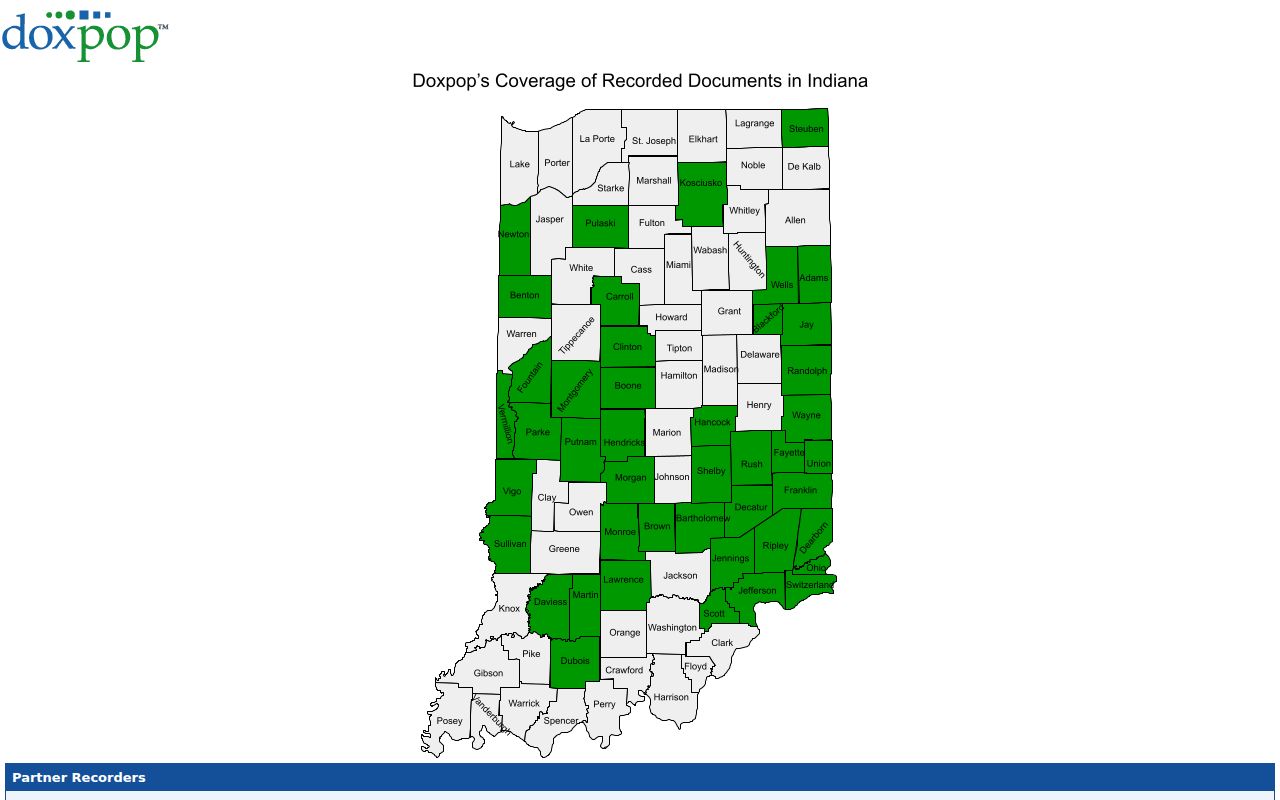
That listing shows the July 2004 line at a glance. Anything earlier belongs to courthouse deed books or microfilm at the library, so plan the handoff without delay.
July 2004 Divides Online and Historic Sullivan Deed Records
Doxpop's coverage for Sullivan County starts with index data in July 2004. Scanned images begin at the same date. Treat that date as an access cutoff, nothing more. Land records in the county run far deeper than the online layer. Recent chains can be finished entirely on the web. Older ones must continue through the recorder's courthouse indexes, bound deed books, and microfilm held locally. That split rewards anyone comfortable moving between paper and screen.
July 2004 forward
Search the online index, inspect available details, follow cross-references, and obtain the needed image.
Before July 2004
For earlier deeds, rely on the recorder's direct and reverse indexes, the cited volumes, Sullivan County Public Library microfilm, and archive catalogs.
The best bridge between online and offline work is the earliest reliable deed you can find on the portal. Record its grantor, grantee, legal description, date, and book, page, or instrument number before you log off. Those details hand the courthouse search a running start.
Sullivan County Preserves More Than an Online Index
The Sullivan County Recorder's office traces its constitutional roots to 1816. It also reports more than 199 years of preserved records. That long public duty dwarfs the Doxpop layer. Doxpop has existed for only a slice of it. A blank web result is not proof that no deed exists. It usually means the record sits in an older book or on microfilm instead. The Sullivan County Public Library's genealogy department holds deed microfilm. It also keeps probate, will, newspaper, and index material. The Indiana State Library lists county maps and plat books too. Those include an 1899 atlas and a 1924 map of property owners. Those historic owner labels can point you toward the right deed book. They do not prove current title, so confirm everything in the recorder's own records.
Following the Sullivan County Grantor-Grantee Index
Recorder indexes across Indiana list the conveying party, the receiving party, a short legal description, the date, and a reference for pulling the instrument. Work a Sullivan County chain backward from the current owner's acquisition. Before you treat the prior party as your next search name, confirm the land description matches. Matching descriptions, not matching surnames, keep the chain tied to the right tract of ground.
- Find the current owner's acquisition with that owner in the grantee role.
- Read the grantor, recording date, legal description, and any cross-reference.
- Search that grantor as an earlier grantee and confirm the same tract.
- Repeat until the chain reaches July 2004, then continue in the appropriate physical index and deed book.
- Grantor
- The party transferring the recorded interest.
- Grantee
- The party receiving the recorded interest.
- Chain of title
- The linked sequence of conveyances affecting the same land.
- Book/page versus instrument number
- Different recorder references used to retrieve a filed document.
Match Every Sullivan Deed to Its Legal Description
A name alone proves little in Sullivan County deed research. Common surnames repeat across generations, and one person may own several tracts at once. Compare the subdivision, lot and block, or section-township-range language at every link in the chain. Parcel clues help, but older instruments often predate the identifier in current use. Rural description habits also explain false positives in filing alerts. The same section-township-range text can recur across townships. A recorded instrument need not carry a street address at all. It may lack an assessor parcel number, too. Read the full legal description and the related parties before adding any item to your chain.
Mortgages, Liens, and Releases Sit Beside Sullivan Deeds
The Sullivan County Recorder preserves far more than conveyances. Mortgages, liens, assignments, satisfactions, releases, and plats all sit in the same deed records. A mortgage may pass to a new holder. A lien may be released. A satisfaction shows a recorded claim was paid. Tie each new entry to the chain through party names, dates, land description, and cross-references. A quick result list with no visible release does not prove a debt still stands. Search name variants and follow document links. Check later filings before concluding anything. Then pull the actual instrument when the question matters. Court enforcement of a mechanic's lien or a quiet-title dispute may surface in MyCase or in the Sullivan County Clerk's file. So both places deserve a look.
Probate Can Interrupt a Simple Sullivan Deed Chain
An estate transfer often takes more than one record to tell its story. MyCase or the clerk's probate file can name the personal representative, the will, the inventory, or the order authorizing a sale. The recorder then supplies the piece that changed the land record itself. An executor's deed, administrator's deed, survivorship filing, transfer-on-death instrument, or affidavit completes the picture. A death certificate proves death for certain transaction needs. It is not a deed, and it conveys nothing. For older estates, the Sullivan County Public Library holds will and probate material, including an index to will books 1 through 7 with nineteenth- and early-twentieth-century coverage described in its resources, which can reopen cases the modern record barely mentions.
Sullivan Filing Alerts Are Clues, Not Title Protection
Doxpop Property Watch monitors a chosen name, parcel, or legal description for documents recorded later. It cannot stop a filing. It also cannot promise a match. An alert is a clue, not title protection. No alert replaces review by the recorder, an attorney, or a title professional.
Look closely at any alert's instrument type, party roles, description, and cross-references. Repeated rural description text can trigger an unrelated match. A filing lacking an APN slips past a parcel-only watch. Build the plan around the owner's exact recorded name style. Add a land description checked word by word.
Getting a Copy of a Sullivan County Deed
Recent non-confidential deed images can be bought through Doxpop, whose announced March 2026 rates are $2.10 per page for free-search users, $1.45 on 20/60 plans, and $1.13 at higher levels, with $1 per page going back to the recorder. Vendor terms change. Confirm the checkout price before paying.
The county's own schedule sets counter copies at $1 per page for pages 11 by 17 inches or smaller, $5 for larger pages, and $5 for certification. The Recorder sits at 100 Courthouse Square, Room 205, Sullivan, Indiana 47882, telephone 812-268-4844, with published weekday hours of 8 a.m. to 4 p.m. Provide the party names, record type, date range, legal description, and a book, page, or instrument number when requesting a copy. Ask first whether a plain or certified copy fits your intended use.
Recorded, not guaranteed. Sullivan County deed records show instruments accepted for recording, not every possible interest or defect. An index search and copy are not a title opinion, so obtain a professional title examination when clear ownership must be established.